
Make Politics Boring Again
More Al Gores, more Pete Buttigiegs, or at least a man can dream

Democratic politics are in a dire state right now. People don’t read much anymore and 52% of TikTok users regularly get their news from the app. Politics is based on vibes these days. Democracy relies on a well-informed electorate–that’s gone. Where cable news has a panel of less-than-professionals, instagram has an infographic from a nobody and twitter has a sarcastic tweet from a brainlet. Clearly not a lot of room for nuance.
But I’m preaching to the choir. Everyone knows this.
Here’s what I’m advocating for: good ol, boring policy wonkerism. Policy is the driver of real, material change. It has the greatest potential to equalize opportunities and create better lives without prejudice. The best policy initiatives go to the root of issues like crime, inequality, climate change, the housing crisis, and everything else, then they work towards fixing them. But this is the boring part of politics. I don’t see a lot of climate activists protesting the freezing of IRA funding. I didn’t see a lot of people seriously engage with Ezra Klein’s abundance agenda. And really, who even noticed all of Biden’s industrial policy wins?
Now I don’t blame people for focusing on social issues; after all, they are extremely important. People should care about abortion, trans rights, and all the rest. Policy is a bore. But its the nuts and bolts of change, the quiet machine working to make your life better every second. There’s the reason DOGE sucks so bad–all those little bureaucrats doing their little thankless tasks were solving all the problems we collectively forgot about and the other ones we never even knew. Simple stuff, like saving 25 million lives with less than 1% of the taxpayer budget.
Policy is also always happening. I don’t blame most people for not being up to date on the 12,754th bill of the year introduced to congress. But some engagement with the real stuff, that’s all I ask. A lot of social politics follow the idea that politics are downstream of culture, but I think culture is downstream of policy.
Now this is maybe a little exaggerated. The mainstream engages with policy from time to time when it’s really big. Think tariffs, Obamacare, climate change. But even still, it’s always a farce of the real policy talk, always some populist fix. Very rarely is it the real nuts and bolts.
Look at the abundance agenda.
Let’s make a guy up, call him Tim. Tim is an average democrat who wants cheaper rents in his city, San Francisco. He is all about rent control because it seems neat: cheap rent if you own a house. But, the economic consensus is that rent control leads to housing scarcity, and this in turn leads to higher rents for most people. There is a demonstrated way to alleviate this housing crisis and it starts with expanding development. That means more affordable housing in Timmy’s area, but he doesn’t like this. That mean’s lowering his property value and maybe even living next to people of a lower socio-economic background! So he goes NIMBY (Not in my Backyard), a movement predicated on feelings about policy instead of facts. Timmy won’t sift through the data, like that Austin, TX is one of the only big cities that, faced with a fast-growing population, managed to lower housing prices all by building more housing. He won’t read Abundance, he’ll read cheap takedowns of it that refuse to really engage with the actualities of the housing crisis because Tim doesn’t want to really engage with the issue at hand.
I know this doesn’t seem like the most objective analysis, but it’s very frustrating because the whole NIMBY/YIMBY divide can be chalked up to those who are burying their heads in the sand and those who are working to solve the problem. And Ezra Klein and these other boring center-left middle aged guys rallying for their tested solutions aren’t convincing people with facts and solid analysis.
Here’s another populist policy coming up in mainstream circles:
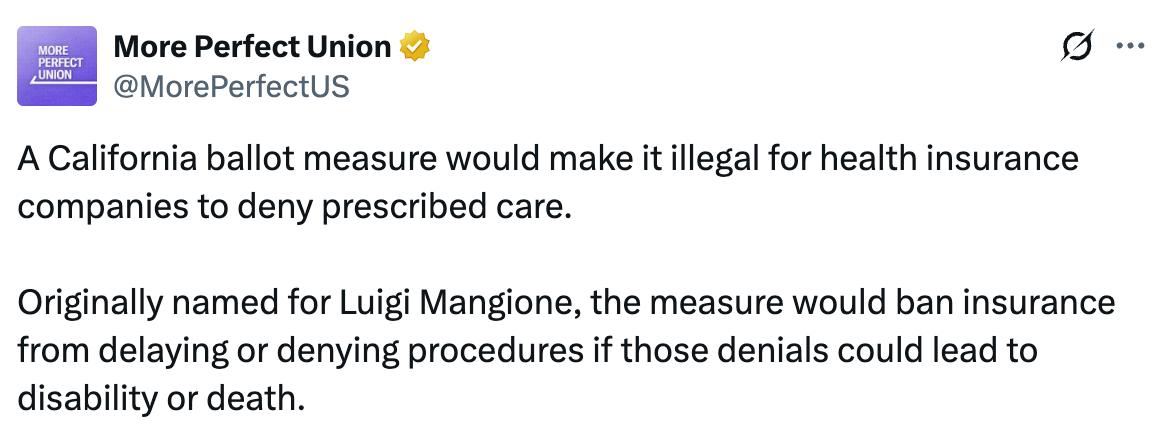
This is like saying a ballot measure saying insurance companies cannot deny flood damage coverage to houses in the Florida coast. This is a joke. It’s a populist policy suggestion that people like because “denying care is bad!,” but any real analysis reveals the simple and true fact that it would make things much worse. Same with rent control, same with more zoning laws, all the rest. Often, systems are predicated on things people don’t like; removing that one thing will not make the system work better. Either rethink it entirely or analyze the available data to figure something out that works to make healthcare more affordable. That would look a lot different from this, but people won’t engage.
And, if nothing else, be more wary of populist policy agendas. Like for example, fogiving student loan debt. On it’s face, this solves the problem that millions face, but then again, its a band-aid fix for the incredibly elitist private university system, and it just is not sustainable from a federal policy perspective. For that one, I don’t really know the answer; higher education is pretty established these days, and it doesn’t look like prices are going down anytime soon. Still, I know forgiving all debt is probably not the best bet we have, and I’m sure there are some professionals out there who can cook up a better scheme.
My overarching position here connects back to the basis of my “be pretentious” argument; if you don’t want to engage with this stuff, fine, but if so, you should not be acting like your opinion is valid. You should feel stupid and out of your depth in political conversations. To have a seat at the table, you must be knowledgeable on policy issues or at least willing to engage with real solutions.
The problem, as I said, is that really engaging is boooo-ring!
What is most erosive to the culture of engaging with complex ideas is sensationalism. By this I am describing the tendency for conversations to steer away from the real nitty gritty stuff, i.e. what has any chance of solving issues.
Let’s look at Israel/Palestine and the ongoing genocide in Gaza.1
Controversial, I know! The American conversation on Gaza really moved away from the crux of the issue, that being children being murdered indiscriminately, and instead became a culture war about the safety of Jews on college campuses. The Powers That Be used antisemitism on campus as their proxy issue and managed to successfully change the conversation. That should be expected, but the thing is that the protestors fell right into the trap. They were defenses of protest slogans against an onslaught of sometimes accurate, oftentimes exaggerated cries of anti-Jewish sentiment. Protestors began to double down on these chants, bringing more fuel for the sensationalist fire.
A lot of protestors would disagree with me here and say that the news was never going to fairly portray what’s going on in Gaza. They were fighting against injustice, they would say, and policing language is far from what they should be spending their time on.
The left-wing protestors became so assured of their righteousness–and they were pretty clearly on the moral high ground here–they forgot how successful protests work: you have to make people see the righteousness! During the civil rights movement, MLK and the NAACP worked to meticulously make sure that in instances of news coverage, they would be portrayed as the victims. They could not give the media a chance to paint them as agitators. People sitting on stools getting beaten, peaceful marchers brutalized by riot police: all these tactics were strategic. As much as I greatly respect Malcolm X, the Black Panthers, and all the other, more militant groups who did not let any enemy control their rhetoric, their efforts were far less effective than MLK’s work.
The Palestine campus protestors were stuck in a middle place between the coalition-building peaceful route and the militant, no-suggestions taken route. The encampments were a perfect display of victimization via peaceful protest facing brutality of campuses and local police. But by refusing to give an inch on their rhetoric and defending chants that could plausibly–often reasonably–be construed as antisemitic, they gave the media an in to spin this into the main issue. Many who cared about Gaza were stuck in this position of defending chants instead of keeping attention on the real issue.
That’s all the conversation became at a point. This non-issue (at least comparatively to the slaughter of civilians) became the main event. The righteous were taken for a ride.
This self-assuredness seems to be a pattern on the left. It is an assumption that their position on issues are abundantly clear to anyone with a brain, but this ignores the work and the strategy that goes into successful political movements. I don’t blame them; I’m sure these protestors open their phones and see videos of Palestinian children being murdered, calls to action, and infographics that explain the nuance of “From the River to the Sea” and how it is definitely not antisemitic. Other Americans are not. Many are seeing Israeli people being bombed, many are reading about the antisemitic connotations of “From the River to the Sea” and the real motives of the campus protestors. Everybody know the media landscape is like this, everyone being pushed deeper into their rabbit-holes, but whenever this becomes relevant for action, it is totally absent from anyone’s decision making.
How quickly we forget what we know!
So, alright. Established that the left has forgotten how real change is made: building coalitions, convincing people on the margins, all the while, putting pride and righteousness aside. Well, unfortunately, the right has forgotten how to be sane.
We had Biden and some great legislative initiatives. (I would go as far as saying the best policy record of any 21st century president by a pretty big margin, but that’s just me.) But Trump, day one, rolled back everything just like that. Now we have the biggest constitutional crisis since the civil war upon us because the Bidenites believed their righteousness was self-evident while the rest of America became so disillusioned with the state of things that they either didn’t vote or were MAGAlized into repealing every progressive win from the last fifty years.
Right now, Donald Trump is testing the integrity of our nation, seeing just how much he can work around the constitution. Every minute detail of his actions is documented across the country in painstaking detail. Every time: can he get away with it?? Every time: Yeah, seems like it.
Where is the outrage? We, the people, are too depressed, reduced to scrolling through jokes and rage bait, knowing that someone’s probably doing something or nobody can do anything or its just too exhausting to think about or who cares or…
People have become a husk of their formerly civically engaged selves, America a parody of a working democracy. Republicans in congress are too pathetic to stand up to the tariffs even if their constituents would support it. Maybe the media landscape isn’t to blame for documenting Trump like this–he really is that crazy. But, it is to blame for the doomerist attitude of its consumers and their subsequent lack of action. These are the people who are supposed to care. Stop the sensationalism!
Well, alright, in the post-truth MAGA world, it doesn’t seem to be the best strategy to all the sudden be boring. I mean, the democrats have been pretty boring for a while, and look how successful they were last November. But look, even in the Obama era, politics was generally boring, even if he was pretty likable. People on the street didn’t act like they knew how the US economy worked because they saw it in a TikTok.
Maybe the problem is just social media, then. It gives the people whatever cope they want to hear, facts be damned. Optimization towards the lowest common denominator garbage, everyone knows that. But then again, the big bore Al Gore didn’t win back in 2000.
Maybe policy was never a big seller.
I don’t know, I guess this is a pipe-dream. As long as populism sticks around, as long as people are dumb and don’t give a shit (and by God, they’re getting dumber!), and as long as we have Instagram, there isn’t a lot of hope for us boring policy wonks. Sensationalism works for the guys who hold the cards. I guess I’ll just sit back with an $8 imported beer and a $12 pack of American spirits, scroll twitter, and cry.
I would like to make it clear I’m focusing on Democrats and leftists because I hold them to a higher standard than their right wing counterparts. This is because I care. It comes from the frustration of seeing like-minded people fail to do a good job on important stuff.
I think this is super interesting and I think you do raise a good point about the mundanity of good policy. I also agree with you about how frustrating sensationalism is and how it undermines EVVERYYY leftist movement these days. However, and I haven't read Abundance, but from what I can tell by your essay is that it doesn't really engage with what is *politically* viable and only focuses on policy that is materially viable, which runs into resistance from NIMBY, etc. I think it is a mistake to dismiss what leads to social movements—you write that you think culture is downstream from policy, but it is a reciprocal relationship, which I think you would agree with because you talk about how Tim interferes with affordable housing construction due to his NIMBY worldview
We all have an inherent worldview and values and ideas about how society should work, which directs our activity and the way we interact with the world and with politics—institutions are run by people and policy is only enacted by people, so it requires people to have faith in institutions/policy and the change that they represent. This institutional development does then lead to material change, which actively affects people and how they interact with the world (in other words, this is where culture is downstream from policy). But then I think it is a mistake to focus only on the relationship between policy and material conditions, when culture and human psychology is the intermediary step, being influenced by material problems while influencing institutions: policy change—>material change—>cultural change—>policy change, and so on and so on.
Biden frankly had the best policy by far out of any president in the last half century. But it didn't stop the movements going on because it was just that: policy. There wasn't a vision or worldview on offer that could change the current narratives propagating everywhere, narratives that convinced people that Trump was what we need. People are just sitting on their phones, yeah, and what makes them get up is a narrative. That's how neo-Nazis recruit—they talk about the world in good vs. evil and in mythological terms (often Norse mythology) that stir up emotions and direct them in a very clear way. It is an evil movement (hardly even an ideology) but that understands how to motivate and direct human activity. This is why I don't think populism is *intrinsically* bad—it isn't an ideology but a type of social movement, a method of mobilizing people, which can be very risky and can easily be tied to racism and xenophobia, but it can also be tied to productive ideology that directs their grievances into changing the issues in our socio-political economic system. So I don't think all of this leftist populist rhetoric about healthcare and housing is inherently bad—it gets people to focus on important issues—and maybe it can be effectively rallied in support of that nitty gritty policy. Or perhaps in support of even bigger, systemic overhaul. IDK. Still, I think it is a mistake to dismiss it. Be pretentious, but don't forget the world is made up of a lot of people that barely even think about these things.
Fun read! If I may add my two cents, part of the issue is also that we have assumed that just because we have the knowledge to identify the problem, it means we have the knowledge to identify the solution. Big progressive outlets like More Perfect Union, like you cited, do not have the ability to get into the necessary granularity of any of these topics - they'd probably lose their following if they tried to. I would be surprised if those running the account had meaningful expertise on most of these topics. A lot of this is also tied to progressive politics as an easy way to virtue signal. It's easy to follow More Perfect Union and be able to have surface level conversations about these topics, than it is to meaningfully engage and discuss.
I've spent the past few months helping organize against public transit cuts in my metro area. I could not even fathom how complicated the system and its funding is beforehand, and I wouldn't have been able to understand that without my co-organizers sharing their years of knowledge, books, resources, and accounts of dedicated reporters on the topic. We all wouldn't have been able to fight the cuts without attending the hours and hours of boring board meetings and reading financial reports from the transit org. Having won that battle, now we are set up with connections and information that lets us push for improvements and changes to our system - an ability that also helps tackle disability rights, class issues, climate change issues, and every other social issue that feels larger than life.
I guess all of this to say, we need *real* experts and leaders, whether on social issues or more specific area, to set us up for long term success. We need people who we can defer to to know the ins and outs of these topics rather than letting our ideas and discourse be shaped by a random tiktoker with a large following, or assuming that I - with no background in finance or education - understand how to solve the student debt crisis. We need to build an identity that relies not on belief or signaling but action and information. Sorry about the ramble! I enjoyed the read! We have a lot of work to do in how we build movements, and reflections like this are the first step.